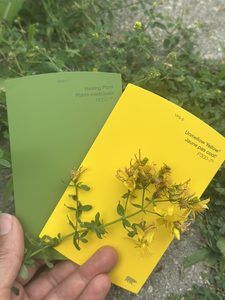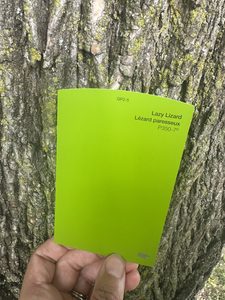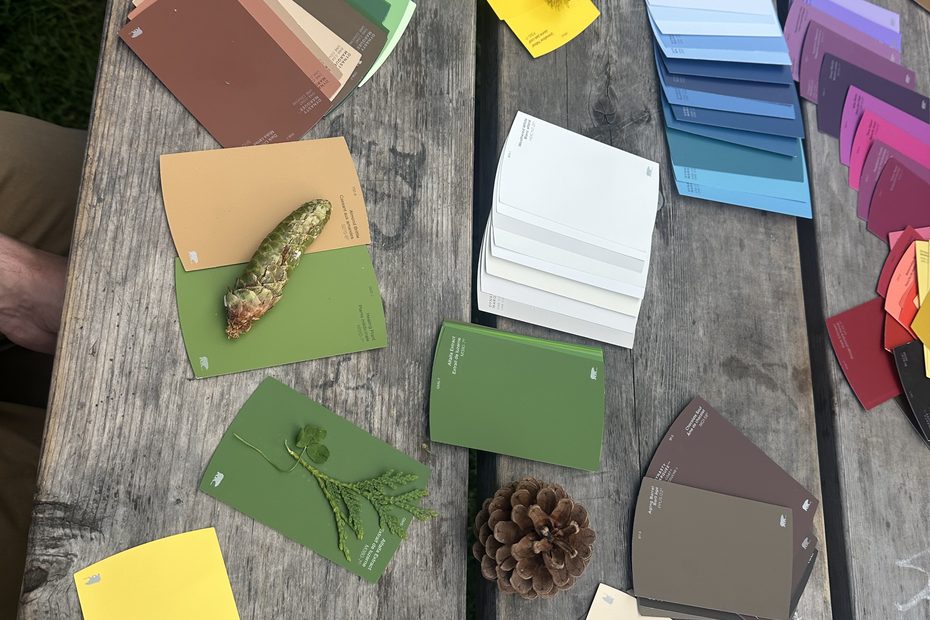
Have you ever tried a paint chip nature scavenger hunt? We did this color matching nature scavenger hunt in the summer and it is one of my very favourite nature scavenger hunt activities. Instead of simply looking for “something green” or “a flower,” you are given a handful of very specific colours and challenged to find something in nature that matches each shade.
This activity isn’t merely “find pretty colors outside.” It’s an invitation to slow down, notice, discern, and wonder. This was also fun for kids, youth, and adults alike.
Materials Needed
This is a super easy outdoor activity for kids that requires few materials and little prep! Here is what you need:
- Paint chip samples in a variety of colours and shades (often available for free from the hardware store)
- An outdoor space to explore—a backyard, park, garden, trail, or schoolyard
- A phone or camera, if you want to photograph your finds
- A small basket or bag, if you want to collect a few fallen natural objects
You don’t need much to make this activity work! The paint chips are the key. Choose several different colours, and—more importantly—choose several different shades of the same colour. The more specific the colours are, the more carefully everyone will have to look.
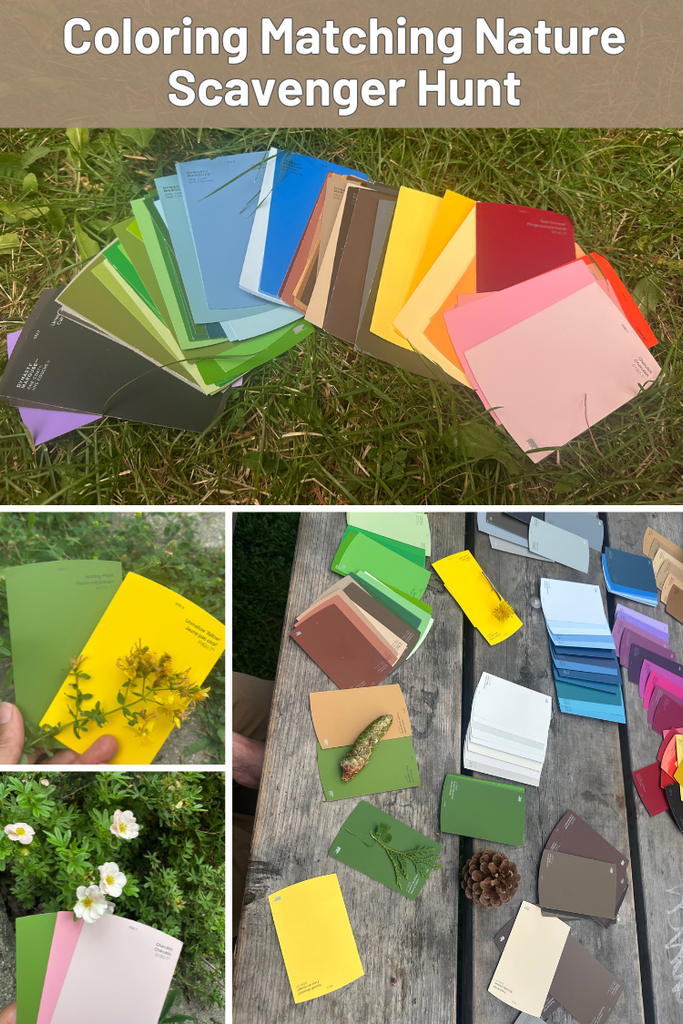
How to Do a Paint Chip Nature Scavenger Hunt
- Start by giving each person a few paint chips. You can let everyone choose their own colours, or hand out a random selection.
- Then head outside and start looking!
- The challenge is to find something in nature that matches each paint chip as closely as possible. Look at leaves, flowers, bark, rocks, moss, grass, berries, feathers, fallen leaves, and anything else you notice along the way. You may find that many things are multiple colors and multiple shades.
- Don’t worry about finding an exact match. Part of the fun is deciding which natural object comes closest to the colour on your paint chip.
- Encourage everyone to slow down and really look. You may discover that what you thought was “green” is actually dozens of different shades of green.
You may want to take a small bag or basket with you and collect small treasures that you find (acorns, fallen leaves, etc.). Or take pictures of things that you find that are either too big to be brought back or things that you don’t want to disturb (if you don’t want to rip out the flower that you found, for example).
Look Closely
One of my favourite things about this activity is that it changes the way you look at the world.
At first, you might think you’re looking for “green.”
But then you notice the green of a maple leaf is different from the green of moss. The green of grass is different from the green of a pine tree. Even two leaves from the same tree might have slightly different shades.
This is a simple activity, but it encourages something we don’t always make time for: paying attention.
What happens when we slow down enough to notice the small differences?
More Ways to Play
This nature scavenger hunt can be adapted for different ages, purposes, and even weather. It makes the perfect summer activity for kids, but it can be used in all seasons.
For younger children:
Give them just 3–5 colours and let them search for something that matches each one.
For older children:
Give them very similar shades—three greens, three browns, three yellows—and challenge them to find the closest match.
For a group:
Give each person or team a different set of paint chips. At the end, compare everyone’s discoveries.
For a photography scavenger hunt:
Instead of collecting anything, take a photograph of each colour match. This is especially useful when you’re in a park or other place where you shouldn’t pick plants.
For a nature journal:
Have children draw one of their colour matches and write down where they found it.
For a rainy day:
Bring the paint chips inside and look through a window for colours in the natural world—or collect natural objects beforehand and do the matching indoors.
For a four-season activity:
Try the same colours in spring, summer, autumn and winter. Which colours are easiest to find in each season?
Explore Gently
When you’re exploring outdoors, remember that we’re visitors in the homes of plants and animals. Look closely, but try not to disturb what you’re finding.
Take photographs instead of picking living plants, and never touch plants you’re unsure about. Fallen leaves, sticks, pine cones and other loose natural objects can make great things to collect and examine.
The goal isn’t to take nature home with us. It’s to slow down enough to notice it.
What Kids Are Learning
This activity is great for preschoolers through to older children, and it can be adapted according to age. (See above: More Ways to Play) It makes a great screen-free activity for all ages. It can be added to a homeschool or forest school lesson. It can be used to Sunday School or Wild Church or Messy Church.
This simple scavenger hunt encourages children to:
- notice details in the natural world
- compare and match colours
- identify different shades and hues
- practice observation and attention
- explore their surroundings
- slow down and become more aware of what is around them
- build vocabulary with all the different names of specific shades
And, of course, they’re getting outside and moving around while they do it!
What Youth and Adults Are Learning
This activity is great for older youth and adults as well. There is so much value in getting outdoors, turning off our phones (we may need to use them for photographs…but shut down the email, social media, and endless scrolling for this activity), and spending some slow time in nature.
For the older youth and adults in the crowd, this nature activity encourages us to:
- notice details in the natural world
- have some time to slow down
- practice observation and looking closely
- discover beauty in nature that we might otherwise overlook
What I most appreciate about this activity as an adult is that it gives me a chance to explore, to play, and to notice the natural world around me.
Use this scavenger hunt for Wild Church, Messy Church, Sunday School or Youth Group
We did this scavenger hunt as part of a Wild Church gathering in the park. We paired it with the parable of the wheat and the weeds and we talked about discernment and how dangerous things (weeds) and good things (wheat) can look a lot like each other.
This summer, I took my oldest kids paddling down the Grand River, and one thing we noticed was the presence of giant hogweed, an invasive plant in sounthern Ontario that looks a lot like really huge Queen Ann’s lace, but one that is poisonous and will burn your eyes and skin if you touch it.
It’s similar for wheat and tares, or poison darnel, the plants that Jesus names in his parable. One is a source of food, and the other is poisonous. Both look a lot alike, especially before they are fully ripe. In Jesus’ parable of the wheat and the weeds, he warns against weeding out the imposters too quickly as you might rip out some of the good plant.
The parable of the wheat and the weeds is a story about patience, about hidden things, and about a world where good and harm grow side by side.
You can also use this parable to talk about discernment and about paying close attention. That’s why it works so well with this scavenger hunt.
After you read the story, you can ask questions like:
- What stood out to you?
- What does this tell us about the world?
- What does this tell us about God?
- What does this tell us about human beings?
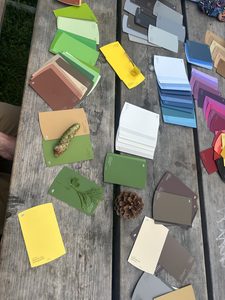
Then we released everyone to practice discernment and paying close attention with this scavenger hunt. Everyone was encouraged to choose a handful of colours and to try to match that specific shade in nature. Some participants choose to take pictures of what they found instead of picking flowers and bringing things back. Everyone was encouraged to participate with gentleness and care and to definitely not uproot plants and pull bark off trees (but gathering things like pine cones that you find on the ground is an excellent idea). Some participants gathering some things that they found and returned with them, and then tried to match them to all the paint chips that we had.
After the scavenger hunt, ask:
- What did you notice that you might normally have walked past?
- Was anything difficult to distinguish from something else?
- Did anything surprise you?
- What happens when we assume we already know what we’re looking at?
- Where might we need patience and careful attention in our own lives?
- What might this teach us about judging what we see on the surface?
You can use this scavenger hunt activity with any story that talks about:
- patience
- going slow
- paying close attention
- look-a-likes and imposters (like giant hogweed and poison darnel)